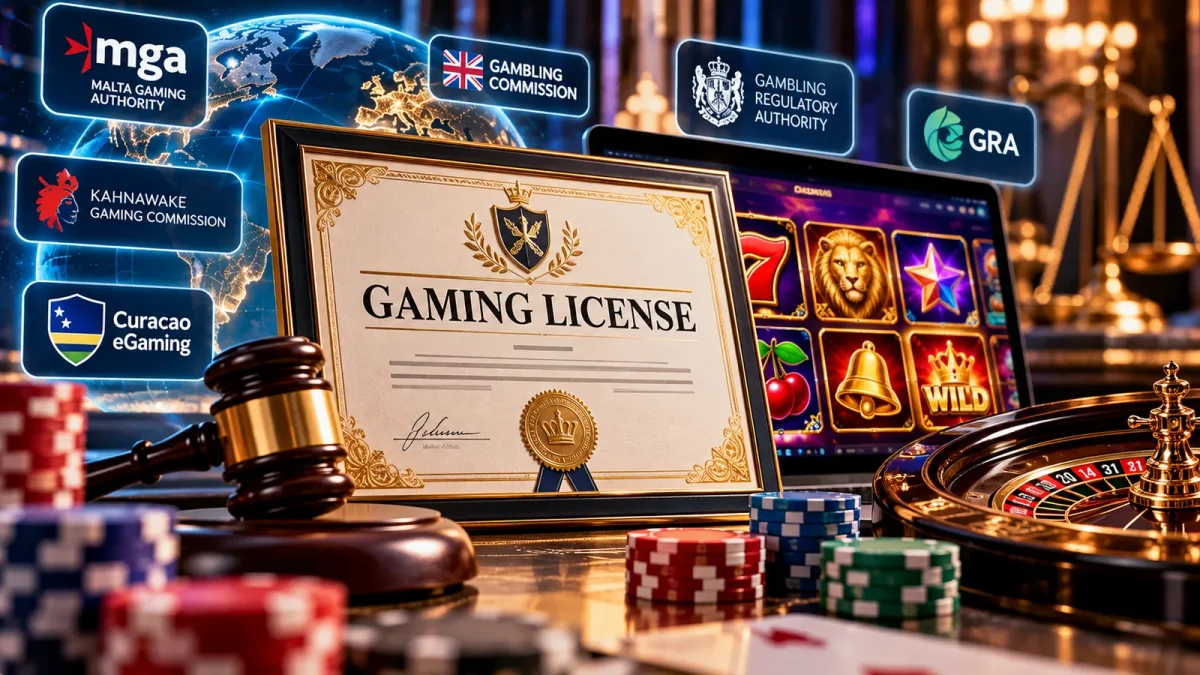
A Gaming License is an official authorisation allowing a business to conduct specified gambling activities under the rules of a particular jurisdiction. For an online casino, sportsbook, poker room or gambling supplier, the licence can determine where it may operate, which products it may provide and which regulatory obligations it must follow.
But a Gaming License is not a universal passport for gambling worldwide. A licence issued in Malta does not automatically authorise an operator to accept players in Great Britain, Sweden, the Netherlands, France or every other country. Many regulated markets require their own local authorisation.
That distinction is essential when checking an online casino. The question is not simply "Does this casino have a Gaming License?" It is also who issued it, what activity it covers, whether it is active and whether that authorisation applies to the player's location.
18+ only. Gambling involves financial risk and should be treated as paid entertainment, not as a source of income. A Gaming License provides regulatory oversight but cannot guarantee winnings or prevent gambling-related harm. Use only services legally available in your jurisdiction, set spending and time limits, never chase losses, and use self-exclusion or professional support if gambling becomes difficult to control.
What Is a Gaming License?
A Gaming License is permission granted by a gambling regulator or competent government authority to carry out one or more regulated gambling activities. Depending on the jurisdiction, separate licences can exist for online casinos, sports betting, poker, bingo, lotteries, gambling software, game hosting and land-based operations.
Receiving a Gaming License normally requires considerably more than registering a company. Regulators can examine ownership, management, finances, criminal history, business plans, technical systems, anti-money-laundering procedures and the proposed gambling products.
Once licensed, an operator normally remains subject to ongoing regulatory obligations. These can include reporting, audits, technical standards, player-protection measures, AML controls and compliance reviews. A Gaming License therefore has two basic functions:
- Market Access. It authorises specified gambling activities within the scope of the licence.
- Regulatory Oversight. It places the licence holder under continuing rules and supervision.
The exact level of oversight differs substantially between jurisdictions.
What Does a Gaming License Actually Do?
A Gaming License establishes a legal relationship between a gambling business and the regulator that issued the authorisation. The operator receives permission to conduct specified activities, while accepting obligations attached to that permission.
Depending on the regulator and licence type, those obligations can cover:
- Company ownership and management.
- Financial suitability.
- Player identity and age verification.
- Anti-money-laundering controls.
- Gambling software.
- Game fairness.
- Technical security.
- Player funds.
- Responsible gambling.
- Advertising.
- Bonuses and promotions.
- Complaints.
- Reporting.
- Record keeping.
- Regulatory audits.
- Suspicious activity.
- Sports-betting integrity.
- Self-exclusion.
- Data and information security.
The presence of a Gaming License therefore provides considerably more information than a casino's own statement that it is "safe" or "trusted."
However, the protection comes from the rules behind the licence, not from the licence logo itself.
Does a Gaming License Mean a Casino Is Safe?
A valid Gaming License is an important regulatory check, but it should not be treated as an absolute guarantee that a casino can never have payment disputes, technical problems or compliance failures. Licensed businesses can still breach rules, which is precisely why regulators have enforcement powers.
A stronger check is to confirm several things together: the operator's legal entity, Gaming License number, current licence status, authorised websites or domains, permitted gambling activities and the regulator responsible for the player's market.
This also explains why seeing a regulator's logo at the bottom of a casino homepage is not enough. The licence should be independently verifiable through the regulator's official register whenever such a register is available.
Major Gaming License Regulators Compared
Gaming License systems are difficult to compare with a single number because they regulate different markets and activities. A national licence can provide extremely strong local protection while being irrelevant outside that jurisdiction.
The following order therefore reflects a practical combination of regulatory depth, operator scrutiny, technical controls, player-protection framework, compliance supervision and relevance to online gambling, rather than claiming that one regulator is universally suitable for every player.
| Regulator | Jurisdiction | Online Casino Licence | Main Role |
|---|---|---|---|
| UK Gambling Commission | Great Britain | Yes | Regulates gambling offered to British consumers |
| Malta Gaming Authority | Malta / regulated MGA operations | Yes | B2C gaming and B2B critical gaming supply |
| Spelinspektionen | Sweden | Yes | Commercial online gambling and betting |
| Kansspelautoriteit | Netherlands | Yes | Licensed remote games of chance |
| Isle of Man Gambling Supervision Commission | Isle of Man | Yes | Online gambling regulation |
| Gibraltar Gambling Division | Gibraltar | Yes | Remote gambling licensing and supervision |
| Alderney Gambling Control Commission | Alderney | Yes | eGambling operations and infrastructure |
| Curaçao Gaming Authority | Curaçao | Yes | Online gaming and supplier licensing under LOK |
| ANJ | France | No online casino licence | Online poker, sports betting and horse-race betting |
| U.S. State Regulators | State-specific | Depends on state | Local online casino, poker and/or betting regulation |
This table immediately shows why the phrase "international Gaming License" can be misleading. Licensing remains jurisdiction-specific even when an operator serves customers in several countries.
1. UK Gambling Commission Gaming License
A UK Gambling Commission Gaming License is required for businesses offering regulated remote gambling to consumers in Great Britain. For online casinos, the relevant authorisation is normally a Remote Casino Operating Licence.
The UKGC's remote casino licence covers games including online slots, roulette, blackjack, poker and other casino games. A business based outside Great Britain still needs the appropriate UKGC Gaming License if it provides remote gambling facilities to British consumers.
This creates an important territorial rule: An MGA, Curaçao or other overseas Gaming License does not replace a UKGC licence when an operator targets the regulated British market.
What Does a UKGC Gaming License Cover?
The UKGC divides authorisation according to gambling activity rather than issuing one generic licence for everything.
Relevant licence categories include:
- Remote casino operating licence.
- Remote casino game host operating licence.
- Remote bingo operating licence.
- Remote betting licences.
- Betting intermediary licence.
- Remote gambling software licence.
- Lottery licences.
- Non-remote casino licences.
- Personal management licences.
- Other activity-specific authorisations.
A Remote Casino Operating Licence allows the holder to provide casino games directly to customers through websites, mobile devices and other remote channels.
A separate game-host licence can apply when a gambling software business hosts games through another operator's platform without contracting directly with the players.
What Does a UKGC Gaming License Mean for Players?
A UKGC Gaming License places the operator within a detailed regulatory framework covering areas such as technical standards, customer protection, compliance and responsible gambling.
It also gives the UKGC enforcement authority over its licence holders. The regulator can investigate compliance and impose regulatory action where obligations are breached.
For a player in Great Britain, this local connection matters more than an impressive collection of unrelated overseas licences. The relevant question is whether the business is authorised for the British market.
2. Malta Gaming Authority Gaming License
A Malta Gaming Authority Gaming License is one of the major European authorisations associated with online gambling. The MGA separates businesses serving consumers from businesses supplying critical gambling technology.
The two principal categories are:
- Gaming Service Licence – B2C.
- Critical Gaming Supply Licence – B2B.
A B2C Gaming License allows an authorised business to offer gaming services to consumers within the scope of its approval. A B2B Critical Gaming Supply Licence applies to businesses supplying and managing critical elements of games or gambling systems.
What Are MGA Type 1, Type 2, Type 3 and Type 4 Games?
The MGA also divides gambling activities into four Gaming Types.
| MGA Type | Activities |
|---|---|
| Type 1 | Casino games, RNG games, house poker, lotteries and virtual sports |
| Type 2 | Fixed-odds betting, including live betting |
| Type 3 | Player-to-player and commission-based games such as poker, bingo and betting exchanges |
| Type 4 | Controlled skill games |
For a conventional online casino offering slots, roulette, blackjack and similar games, Type 1 is particularly relevant.
The distinction between B2C/B2B and Types 1–4 is important. B2C and B2B describe the nature of the licensed service, while the numbered Gaming Types identify the categories of gaming activity covered.
What Does an MGA Gaming License Provide?
MGA applicants must go through a formal application process and submit regulatory and system documentation. Approved gaming verticals also require the appropriate authorisation before being offered.
A casino displaying an MGA Gaming License should therefore be checked against the MGA's own authorisation records rather than relying on the logo alone.
This verification can reveal the licence holder, licence number, licence status, approved Gaming Types and other relevant authorisation information.
3. Swedish Gaming License – Spelinspektionen
A Swedish Gaming License is required for operators providing regulated gambling to the Swedish market. Spelinspektionen, the Swedish Gambling Authority, licenses commercial online gambling and betting under Sweden's national framework.
Commercial online gambling licences can cover casino games, online bingo and computer-simulated gaming machines.
The Swedish system places particular emphasis on player protection. Licensed operators have a statutory duty of care, which includes monitoring gambling behaviour and taking action where necessary to reduce excessive gambling.
What Does a Swedish Gaming License Give Players?
A Swedish Gaming License connects the operator to several locally enforceable safeguards.
The framework includes:
- Duty-of-care obligations.
- Responsible-gambling requirements.
- National self-exclusion.
- Rules concerning bonuses.
- Marketing restrictions.
- Protection of minors.
- Regulatory supervision.
Sweden operates the Spelpaus self-exclusion system, which allows players to exclude themselves across licensed gambling providers participating in the regulated market.
This demonstrates an important advantage of locally focused Gaming License systems: player-protection tools can operate across the regulated national market rather than only within one casino account.
4. Netherlands Gaming License – Kansspelautoriteit
A Netherlands Gaming License for regulated remote gambling is issued under the country's Remote Gambling Act framework and supervised by the Kansspelautoriteit, commonly abbreviated as KSA.
Only an operator holding the required authorisation may legally offer the relevant regulated online games of chance in the Netherlands.
The Dutch remote framework covers categories including:
- Online casino games played against the licence holder.
- Casino games where players compete against one another.
- Sports betting.
- Horse-racing and harness-racing betting.
The Gaming License is therefore tied directly to access to the Dutch regulated market.
Why Does a KSA Gaming License Matter?
The KSA maintains a regulated licensing framework rather than recognising any overseas Gaming License as automatic permission to serve Dutch consumers.
This illustrates a recurring rule throughout modern online gambling:
Where a country operates its own licensing system, a foreign licence does not automatically provide local market access.
Operators must satisfy the requirements applying to the Dutch licence itself.
5. Isle of Man Gaming License
The Isle of Man has a long-established regulatory framework for online gambling overseen by the Gambling Supervision Commission.
Its remote gambling regime covers operators carrying out regulated online gambling activities from the jurisdiction under the applicable legal framework.
An Isle of Man Gaming License is particularly relevant to international gambling businesses that establish regulated operations within the jurisdiction.
What Does an Isle of Man Gaming License Mean?
The authorisation brings an operator within the supervision of the Isle of Man Gambling Supervision Commission. The regulatory framework addresses the operation of online gambling businesses rather than functioning as a simple company-registration certificate.
As with every Gaming License in this guide, territorial scope remains critical. Holding an Isle of Man licence does not by itself override the gambling laws of every country from which a player might access the website.
6. Gibraltar Gaming License
Gibraltar is another established licensing jurisdiction for remote gambling businesses. Gambling operators authorised there operate under Gibraltar's gambling legislation and regulatory supervision.
A Gibraltar Gaming License can cover remote gambling activities conducted within the scope of the operator's authorisation.
Gibraltar has historically attracted major international gambling businesses, but its Gaming License should still be interpreted according to the markets the operator is legally permitted to serve.
Does a Gibraltar Gaming License Work Everywhere?
No. A Gibraltar Gaming License does not automatically authorise an operator in every country.
If the same business wants to accept customers in a market requiring local licensing, it may need an additional authorisation. Great Britain is a straightforward example: a Gibraltar-based operator serving British consumers requires the appropriate UKGC licence.
The same principle applies throughout regulated gambling markets.
7. Alderney eGambling License
The Alderney Gambling Control Commission issues eGambling licences under its regulatory framework. Its licensing system separates customer-facing gambling operations from the technical execution of gambling transactions.
There are two principal categories.
| Licence | What It Authorises |
|---|---|
| Category 1 | Organisation and preparation of gambling operations, player registration and verification, customer contracts and management of player funds |
| Category 2 | Effecting gambling transactions and operational management of a gambling platform at an approved hosting centre |
A business can require one or both categories depending on how its gambling operation is structured.
Why Are Alderney Category 1 and Category 2 Different?
The separation reflects two fundamentally different parts of online gambling.
Category 1 focuses on the relationship with the player: registering customers, verifying them, contracting with them and managing their funds.
Category 2 focuses on the infrastructure that actually processes gambling transactions.
This makes the Alderney Gaming License framework a useful example of why the phrase "licensed casino" can hide several distinct regulated functions.
8. Curaçao Gaming Authority License
Curaçao's online gambling framework changed substantially with the introduction of the National Ordinance on Games of Chance, commonly referred to as the LOK.
The LOK entered into force on 24 December 2024, and the Curaçao Gaming Authority, or CGA, became responsible for licensing and supervising the online gaming sector under the new framework.
This is important because older explanations describing Curaçao purely through the former master-licence and sub-licence structure are no longer an accurate description of the current system.
What Types of Curaçao Gaming License Exist Now?
Under the current framework, the CGA handles applications for:
- Online Gaming Licences.
- Supplier Licences.
An Online Gaming License is required to offer remote gaming in or from Curaçao within the scope of the LOK.
Supplier licensing applies to specified critical gambling-related services and goods. This can include game suppliers, online slot suppliers, sportsbook software, peer-to-peer gambling software and live-studio game suppliers established in Curaçao.
What Changed With the Curaçao Gaming License?
The modern CGA system replaces the simplistic idea that an operator merely operates underneath another company's master licence.
Licensing and supervision now sit directly within the statutory LOK framework administered by the Curaçao Gaming Authority.
For players, this makes the date and status of a Curaçao licence particularly important. Old claims about a Curaçao sub-licence should not automatically be treated as evidence of current CGA authorisation.
9. French ANJ Gaming License
France demonstrates why Gaming License terminology needs to be precise. The Autorité Nationale des Jeux, or ANJ, regulates authorised online gambling, but France does not issue online casino licences for slots, roulette or online blackjack.
The online categories open to ANJ authorisation are:
- Sports betting.
- Horse-race betting.
- Online poker.
Operators must apply for authorisation for the relevant category, and an ANJ approval is granted for a defined period and can be renewed.
Can an MGA or Curaçao Gaming License Make an Online Casino Legal in France?
No. A foreign online casino Gaming License does not override French law.
Online casino games remain prohibited under the French framework. An operator cannot make slots or online roulette legal for French consumers simply by displaying an MGA, Curaçao, Gibraltar or another overseas Gaming License.
This is one of the clearest examples of why players should verify local authorisation rather than simply looking for any licence logo.
10. U.S. State Gaming Licenses
The United States does not use one federal Gaming License that automatically authorises online casino gambling throughout the country. Regulation is primarily state-specific, and legal online gambling products vary considerably between states.
Where regulated online casino gaming exists, operators and their partners must comply with the applicable state framework.
This means a Gaming License valid for online casino activity in one U.S. state does not automatically permit the same operator to offer the same product in another.
How Do U.S. Gaming Licenses Differ From European Licences?
The main difference is market structure. Several European regulators operate national licensing systems, while U.S. online gambling authorisation is fragmented between individual states.
A player should therefore check:
- The state.
- The authorised operator.
- The approved website or app.
- The permitted gambling product.
- Geolocation requirements.
- Minimum legal age.
- The responsible state regulator.
A generic claim that a casino is "licensed in the USA" provides too little information to verify legality.
What Types of Gaming License Exist?
Gaming License classifications depend on jurisdiction, but the industry can broadly be divided into several functional categories.
| Gaming License Type | Typical Purpose |
|---|---|
| B2C Operator Licence | Allows a business to provide gambling directly to players |
| B2B Supplier Licence | Covers gambling software or critical services supplied to operators |
| Remote Casino Licence | Covers online slots and casino games |
| Sports Betting Licence | Covers fixed-odds or other authorised betting |
| Poker Licence | Covers regulated poker operations |
| Bingo Licence | Covers bingo products |
| Lottery Licence | Covers authorised lottery activity |
| Software Licence | Covers development or supply of gambling software |
| Game Host Licence | Covers hosting games for other operators |
| Land-Based Casino Licence | Covers physical casino gambling |
| Personal Licence | Applies to specified managers or staff |
| Premises Licence | Applies to approved physical gambling premises |
A company can need several authorisations at the same time. The exact combination depends on what the business does and where it operates.
What Is a B2C Gaming License?
A B2C Gaming License allows an authorised operator to provide gambling services directly to consumers. The casino, sportsbook or poker operator has the commercial relationship with the player.
This typically means the B2C operator handles areas such as:
- Player accounts.
- Deposits.
- Withdrawals.
- KYC.
- Customer support.
- Gambling transactions.
- Responsible-gambling controls.
The MGA explicitly describes its Gaming Service Licence as a B2C authorisation to offer or carry out a gaming service.
For a player checking an online casino, the B2C licence is usually more directly relevant than a supplier's B2B licence because it covers the business holding the customer relationship.
What Is a B2B Gaming License?
A B2B Gaming License applies to businesses supplying regulated technology or services to gambling operators rather than primarily accepting wagers from consumers.
This can include:
- Slot developers.
- Gambling platforms.
- Game aggregators.
- Sportsbook technology.
- Back-office systems.
- Live casino infrastructure.
- Critical gambling software.
For example, the MGA issues a Critical Gaming Supply Licence for businesses providing material elements of games and certain critical gaming software.
The current Curaçao framework also provides for supplier licensing covering critical gambling services and products.
A B2B Gaming License does not automatically mean the supplier is licensed to operate a consumer-facing online casino.
What Is a Remote Gaming License?
A Remote Gaming License authorises specified gambling activities delivered through remote communication. In practical terms, this usually includes websites, mobile applications and other online systems.
The exact products covered depend on the licence.
A remote casino licence may cover slots, blackjack and roulette, while a separate remote betting licence may be needed for sports betting. Other licences can apply to bingo, poker, lotteries or software.
This is why a casino should not merely state that it has a "remote licence." The authorised activity needs to match the product actually being offered.
What Is a Gambling Software License?
A gambling software Gaming License regulates businesses that manufacture, supply, install or adapt software used for gambling.
The UKGC, for example, has a dedicated Remote Gambling Software Licence. Software supplied under that authorisation must be capable of deployment in accordance with applicable remote gambling and software technical standards.
The distinction matters because a licensed game developer and a licensed casino perform different functions.
A provider's software licence does not automatically license every website using that provider's games.
Players should therefore verify the casino operator separately.
What Does a Gaming License Check Before Approval?
The precise application process varies, but a Gaming License application can involve extensive scrutiny of the company and the people controlling it.
Regulators can examine areas including:
- Corporate Ownership. Who owns and controls the business.
- Management. Whether key people are suitable for regulated gambling.
- Financial Resources. Whether the applicant has sufficient financial capacity.
- Source Of Funds. Where relevant business capital originates.
- Business Model. What gambling activities will be offered.
- Technical Systems. How the platform, games and records operate.
- AML Controls. Procedures designed to identify and mitigate money-laundering risks.
- KYC Systems. Processes for verifying customers where required.
- Player Protection. Responsible-gambling procedures and controls.
- Regulatory History. Previous licensing, sanctions or compliance issues where relevant.
Passing the application is only the beginning. Holding a Gaming License generally creates continuing obligations throughout the life of the authorisation.
Gaming License and KYC
A Gaming License frequently sits behind the KYC requirements encountered when creating or using a casino account. Licensed operators can be required to establish who their customers are and conduct additional checks where legally necessary.
KYC can involve verifying:
- Name.
- Date of birth.
- Address.
- Identity documents.
- Payment ownership.
- Source of funds or wealth in applicable circumstances.
These requirements vary between jurisdictions and situations.
KYC should therefore not automatically be interpreted as a casino creating unnecessary obstacles to withdrawal. At a regulated operator, verification can be part of the Gaming License and anti-money-laundering framework.
Gaming License and Anti-Money-Laundering Rules
Gaming License frameworks commonly operate alongside anti-money-laundering obligations. Gambling businesses can face risks involving stolen funds, identity fraud, payment abuse and attempts to disguise the origin of money.
AML controls can require operators to monitor transactions, identify unusual activity, retain records and conduct enhanced checks when appropriate.
This is another reason why a Gaming License is more than permission to host casino games. It places the operator inside a broader financial and compliance system.
Gaming License and Game Fairness
A Gaming License can impose requirements concerning gambling software, technical standards and the fairness or integrity of games.
The exact process varies by jurisdiction. It can involve approved testing, technical documentation, certification, audits or regulator-defined software requirements.
However, a regulator's logo should never be interpreted as proof that every advertised RTP on a casino website is automatically correct.
Individual games can have different mathematical configurations. Casino Critic's guide on how to check a slot RTP explains why the percentage displayed in the actual game is the most relevant figure when several approved versions exist.
Gaming License and Responsible Gambling
Responsible-gambling obligations are an important part of many modern Gaming License systems. Requirements vary, but regulated operators can be required to provide tools or interventions intended to reduce gambling harm.
Depending on the jurisdiction, these can include:
- Deposit limits.
- Time limits.
- Loss limits.
- Reality checks.
- Cooling-off periods.
- Time-outs.
- Self-exclusion.
- Behaviour monitoring.
- Restrictions on marketing.
- Protection of minors.
National systems can go further by connecting self-exclusion across multiple licensed operators.
The existence of these controls does not make gambling financially safe. They are safeguards designed to help reduce risk and provide routes for players who need to stop.
Does a Gaming License Protect Player Funds?
A Gaming License can impose rules concerning player money, but the precise protection varies substantially by regulator.
Some frameworks establish specific requirements for handling customer funds, while others use different financial or reporting controls.
Players should therefore avoid assuming that "licensed" always means deposits are protected in exactly the same way as money held by a bank.
The correct question is: what does this particular Gaming License require the operator to do with player funds?
Does a Gaming License Guarantee Withdrawals?
No Gaming License can guarantee that every withdrawal will be instant or dispute-free. What regulation can provide is a framework governing how licensed operators must conduct their business and, depending on the jurisdiction, routes for complaints or dispute resolution.
Withdrawal delays can arise from legitimate verification, payment processing, bonus conditions or compliance checks. They can also indicate poor operator practices.
The licence therefore matters because it establishes who supervises the operator and what regulatory obligations apply when problems occur.
How to Check a Gaming License
A Gaming License should be verified through the regulator rather than accepted solely because a casino displays a badge.
The process is usually straightforward:
- Find The Legal Entity. Look in the casino footer, terms and conditions or licensing section for the company operating the website.
- Find The Gaming License Number. Record the complete number rather than relying on a regulator logo.
- Identify The Regulator. Determine which authority supposedly issued the licence.
- Open The Regulator's Official Register. Do not rely on a screenshot supplied by the casino.
- Search The Legal Entity Or Licence Number. The name should correspond with the casino's stated operator.
- Check The Status. Confirm that the Gaming License is active rather than suspended, surrendered, revoked or expired.
- Check The Domain. Where the regulator lists approved domains, confirm that the exact casino website appears.
- Check The Licensed Activity. A sports-betting licence should not be assumed to cover online casino games.
- Check Your Market. Confirm that the Gaming License actually authorises gambling services in the jurisdiction where the account is being used.
- Investigate Any Mismatch. A different company name, missing domain or unverifiable licence number deserves further checking before depositing.
A legitimate Gaming License should survive independent verification. A logo is advertising; the regulator's register is evidence.
How to Spot a Fake Gaming License
A fake Gaming License often relies on the assumption that players will recognise a regulator's logo but never verify it.
Warning signs include:
- No licence number.
- No legal company name.
- A licence number that produces no official result.
- A regulator logo that does not link to a verification record.
- A different company in the official register.
- A domain absent from the authorised record where domains are listed.
- Claims about an obsolete licence structure.
- A suspended or revoked Gaming License presented as active.
- A B2B supplier licence presented as a B2C casino licence.
- Claims that one foreign licence makes the casino legal everywhere.
The last point is particularly important. There is no single Gaming License that overrides every country's gambling laws.
Does One Casino Need More Than One Gaming License?
Yes. An international operator can need multiple Gaming Licenses because different markets impose different authorisation requirements.
A hypothetical operator might hold an MGA Gaming License for part of its European business, a UKGC licence for Great Britain, a Swedish licence for Sweden and a KSA licence for the Netherlands.
Those licences do not simply duplicate one another. Each connects the operator to a different legal and regulatory market.
This also explains why a casino may restrict registration when a player changes country. Legal availability is determined by market authorisation, not merely by whether the website is technically accessible.
Is an Offshore Gaming License Legal?
The phrase "offshore Gaming License" does not answer whether a casino is legal for a particular player. The licence may be completely valid in the jurisdiction that issued it while providing no authority to serve another regulated country.
Curaçao, Gibraltar, Alderney and the Isle of Man can all issue genuine gambling authorisations under their respective legal systems.
The separate question is whether a casino holding that Gaming License may legally accept a player in the player's own jurisdiction.
For example, an overseas licence does not substitute for UKGC authorisation when targeting Great Britain, nor does it make prohibited online casino games legal in France.
Local Gaming License vs International Gaming License
A local Gaming License is normally issued specifically for access to a regulated national or subnational market. Examples include UKGC in Great Britain, Spelinspektionen in Sweden and KSA in the Netherlands.
"International Gaming License" is less precise. It is commonly used to describe licences held by businesses operating across borders, but it should not be understood as universal legal permission.
| Question | Local Market Licence | Overseas/Cross-Border Licence |
|---|---|---|
| Covers a defined local market | Yes | Depends on local law |
| Overrides another country's law | No | No |
| Local regulator can supervise market activity | Yes | Depends on jurisdiction |
| Makes casino legal worldwide | No | No |
| Should be independently verified | Yes | Yes |
The safest interpretation is therefore jurisdiction-specific: which regulator authorises this operator to serve this player with this gambling product?
Gaming License vs Casino License
Gaming License is the broader term. A casino licence is a type of Gaming License covering casino gambling activities.
Depending on the regulatory system, separate authorisations may exist for:
- Casino games.
- Betting.
- Bingo.
- Poker.
- Lotteries.
- Software.
- Game hosting.
- Gaming machines.
An operator advertising sports betting and slots may therefore need more than one licensed activity.
Gaming License vs Game Provider License
A casino operator Gaming License and a game provider licence regulate different businesses.
The casino licence covers the operator that interacts with players, accepts deposits and wagers and processes withdrawals. A supplier or software licence covers the business creating or providing the gambling technology.
A licensed slot developer does not automatically make an unlicensed casino legitimate.
The distinction is similar when comparing casino games themselves. Casino Critic's guide to 5 reel slots explains how games can differ in RTP, paylines and mechanics, but those game characteristics remain separate from the Gaming License of the operator offering them.
Can a Gaming License Be Suspended or Revoked?
Yes. A Gaming License is conditional authorisation rather than permanent ownership of a regulatory status.
Depending on the regulator and violation, enforcement can include:
- Warnings.
- Additional licence conditions.
- Financial penalties.
- Suspension.
- Restrictions.
- Licence revocation.
A casino that was legitimately licensed several years ago should therefore not automatically be assumed to remain licensed today.
Current status matters.
This is another reason to verify a Gaming License immediately before creating an account rather than relying on an old review or screenshot.
What Happens If a Casino Has No Gaming License?
An unlicensed casino operates without the authorisation that would otherwise connect it to the relevant gambling regulator. The practical consequences depend on the player's jurisdiction and the operator's location.
Potential problems include the absence of locally enforceable regulatory requirements, weaker complaint routes and uncertainty over who supervises the operator's conduct.
The absence of a relevant Gaming License should therefore never be treated as a minor technical detail.
Even when a website accepts registrations and payments, technical accessibility does not establish legal authorisation.
Does a Gaming License Make Gambling Fair?
A Gaming License can impose standards intended to protect game integrity and require compliant gambling systems, but the licence does not remove the mathematical casino advantage.
Slots still operate with RTP below 100% in ordinary commercial configurations, while table games contain house edges determined by their rules and payouts.
For example, how to play blackjack depends partly on table-specific rules such as blackjack payout, dealer soft-17 behaviour, doubling and splitting. A Gaming License regulates the environment in which the game is offered; it does not turn a negative-expectation casino game into a guaranteed way to profit.
Regulated does not mean risk-free.
Gaming License Checklist Before You Deposit
A Gaming License check should take only a few minutes and can reveal major problems before money enters a casino account.
| Check | What You Want to Confirm |
|---|---|
| Regulator | Real recognised gambling authority |
| Legal entity | Matches the operator named by the casino |
| Licence number | Exists in official records |
| Status | Active/current |
| Website | Exact domain is authorised where listed |
| Activity | Casino/betting/poker activity actually covered |
| Market | Licence is relevant to your jurisdiction |
| B2C/B2B | Operator licence, not merely supplier approval |
| Complaints | Available route under the regulatory framework |
| Responsible gambling | Required player-protection controls are accessible |
If several of these details cannot be verified, the presence of a Gaming License badge alone should not settle the question.
What a Gaming License Really Tells You
A Gaming License tells you who legally stands behind a gambling operation, which regulator supervises it and what activities it has been authorised to conduct. That makes licensing one of the first checks worth making before depositing at an online casino.
The regulator's name alone is not enough. A proper Gaming License check includes the licence holder, number, status, domain, authorised gambling products and geographical scope.
UKGC, MGA, Spelinspektionen, KSA, Isle of Man, Gibraltar, Alderney and Curaçao all operate genuine regulatory systems, but they do not perform an identical legal function in every country. France demonstrates the limitation especially clearly because its ANJ authorisations do not include online casino games, while U.S. licensing varies between individual states.
The simplest rule is also the most useful: never ask only whether a casino has a Gaming License. Ask whether it has the correct active Gaming License for the game and market in which it is being used.